
THE CADDIEINSIGHT METHOD
A measured path to a repeatable swing
Most range sessions produce feelings. The Method produces numbers. Film a swing on your phone, let CaddieInsight measure it, train the one thing the report flags, then film again. You are not finished when a swing feels better — you are finished when the next report agrees.
The loop
Film → Measure → Prescribe → Train → Re-film. Five steps, repeated until the numbers hold.
01 — FILM
Set your phone at hip height, face-on or down the line, sound on. Hit a few balls with a few seconds between them. No trimming, no editing — CaddieInsight finds each strike from the sound of impact.
02 — MEASURE
Every swing gets its own numbers: backswing and downswing times, tempo ratio against the 3.0:1 benchmark, head sway and hip slide in shoulder widths — plus a key-position strip, a centerline overlay, and quarter-speed slow motion.
03 — PRESCRIBE
Each flagged number maps to a short family of drills, and every drill carries an aim, a step-by-step protocol, a dosage, and a re-film target written in the same units the report prints. A clean report gets a maintenance set instead.
04 — TRAIN
Run the prescribed drills between filmed sessions. Most need a mirror, a stick, a band, or nothing at all — every drill family includes work you can do without buying anything.
05 — RE-FILM
Same club, same camera height, same angle. If the flagged number is back inside its threshold, it is fixed. If not, the plan continues. Either way, nobody has to guess.
The four numbers
CaddieInsight reports many measurements, but four of them drive the Method. Each has a threshold, and each threshold has a reason.
1. Tempo ratio
Benchmark 3.0:1 Flagged under 2.4:1
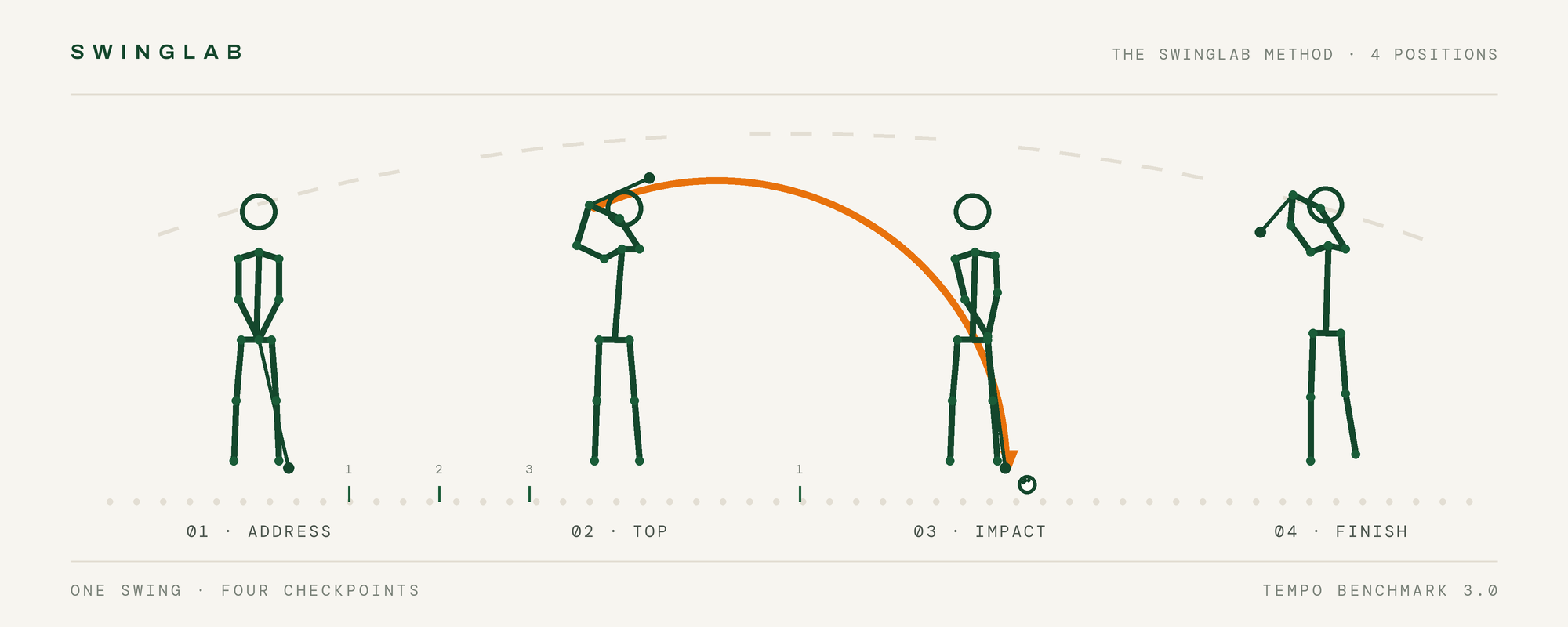
What it is. Backswing time divided by downswing time. Tour players average about 3.0:1, with a downswing near 0.25 seconds.
Why it costs you strokes. A low ratio almost always means the club changed direction before the backswing finished. The sequence compresses, the hands take over the strike, and the same feel produces different contact ball to ball.
What good looks like. Every swing at or above 2.4:1, with the session mean trending toward 3.0:1.
2. Head sway
Flagged beyond 0.35 shoulder widths
What it is. How far your head travels away from the target between address and the top, measured in shoulder widths — positive means away from the target.
Why it costs you strokes. Drift off the ball and the swing's low point drifts with it. Striking the ball first now requires an equal slide back — a second move that has to be timed on every swing. That timing is where the strokes go.
What good looks like. 0.35 shoulder widths or less on every swing. The head may rotate; it should not travel.
3. Hip slide
Flagged beyond 0.35 shoulder widths
What it is. Lateral hip movement away from the target between address and the top, in shoulder widths.
Why it costs you strokes. A slide looks like a turn but loads nothing. The trail hip never coils, pressure hangs on the outside of the trail foot, and the downswing starts with nothing to push from.
What good looks like. At or below 0.35 shoulder widths, with the feeling of turning into the trail hip rather than sliding across it.
4. Consistency
Good under 0.30 std dev Flagged at 0.30 and above
What it is. The standard deviation of your tempo ratio across the session's swings — it takes at least two swings to compute, and three or more to mean much.
Why it costs you strokes. One good swing is a coincidence. If tempo varies noticeably from ball to ball, every shot is hit with a slightly different swing, and the scorecard shows the spread.
What good looks like. A standard deviation under 0.30 across the session. The report says so when you get there — low variance is itself a finding worth keeping.
Every lateral number is normalized by your shoulder width at address, so results compare cleanly no matter where the phone stands. All of it is an automated estimate from a single camera — sharp enough to train against, not a substitute for a teaching professional.
Flag → drill → tool
Every report flag has a drill family, and every drill family is built around a simple tool. These are the same matches the app makes on your results page.
| Report flag | Drill family | Matching tool |
|---|---|---|
| tempo | Three-beat count · Late whoosh · Pause at the top | Tempo Trainer Swing Wand · Clip-On Swing Metronome |
| sway | Stick outside the trail foot · Mirror head box | Alignment Stick Set (3-Pack) · Full-Length Swing Mirror |
| hip-slide | Banded turn · Trail-pocket turn | Anti-Sway Hip Resistance Band |
| consistency | One count, every club · Rehearsal pairs | Clip-On Swing Metronome |
| no flags | Baseline re-film · Mirror checkpoints | Full-Length Swing Mirror |
None of the drills require a purchase — each family includes a version that uses a doorframe, a wall, or counting out loud. The tools make the reps honest and repeatable.
A week on the Method
Say your last report flagged tempo and everything else came back clean. A working week looks like this: two short practice blocks, then a filmed session to check the work.
SESSION 1 — RANGE · 40 MIN
Three-beat count
Warm up, then 3 sets of 10 swings to a steady count or a clip-on metronome: away on one, top on three, down on the next beat — never before it. Start at half speed and build up while the count holds. Finish with ten normal balls at the same count.
SESSION 2 — HOME · 20 MIN
Pause at the top
2 sets of 10 swings: hold a full one-second pause at the top, start down from the dead stop at about 70% effort, and shrink the pause to a beat over the set. A minute of mirror checkpoints makes a good warm-up.
SESSION 3 — RANGE · RE-FILM
Late whoosh, then film
3 sets of 8 with a weighted tempo wand: make the loudest whoosh happen past the ball, never at the top. Then set the phone at hip height and film five swings for the next report.
Re-film and compare
The re-film is the honest part. Keep conditions identical — same club, same camera height, same angle — so the numbers compare cleanly, and film at least three swings so consistency can be measured. Then read the new report against the targets the plan set:
- Tempo ratio at or above 2.4:1 on at least four of five swings, trending toward 3.0:1
- Head sway from address to the top at or below 0.35 shoulder widths on every swing
- Hip slide at or below 0.35 shoulder widths
- Tempo standard deviation under 0.30 across the session
Hit the targets and the flag clears — the next report prescribes maintenance instead. Miss them and the plan simply continues.
The free plan includes one full analysis every month — report, slow motion, overlay, and practice plan included. The gear is optional; the numbers are not.